Background
Scottish Water contacted WGM regarding several improvement areas that had been identified from internal health and safety inspections.
This was spread over eight areas, including:
- the storm screens
- the inlet works
- combined sewer overflows (CSO) and primary settlement tanks (PST)
- activated sludge process (ASP) gratings
- screw pump building
- aeration gantry
- final settlement tank (FST) areas
- final effluent
The scope of works included a platform, new handrailing, OMF panels, support steelwork, new brackets, gates and stairs treads. A lot of the issues on-site involved ensuring the site was compliant with the current Scottish water specifications.
Fabrication
The total job was split into areas for manufacture and pricing. This ensured nothing was missed. Each area had its own individual requirements. In some areas, access was unobstructed and work could commence immediately, whereas some required the site to be prepared beforehand. Subcontractors were engaged to help facilitate this.
Additional processes and subcontractors
The following subcontractors were managed in accordance with the replacement programme: Highland Colour Coaters – after the gratings and support steel had been fabricated in the workshop, they were sent for hot dip galvanising. A single coat at 85 microns has a guaranteed minimum lifespan of 25 years in a highly corrosive environment.
Lyndon SGB – owing to access issues, scaffolding was required to gain sufficient access for the installation of the ASP beam and around the penstock at the FST area.
Barnshaws – the handrail requirements for the ASP gratings involved a curved area. To facilitate the required edge protection, Barnshaws was used to roll the kickplate and the handrail tube to the required radius.
Hiab Hire Scotland – Hiab was utilised for the transport of materials, the installation of the ASP beam and the removal and reinstallation of the penstock at the final settlement tanks.
Lochlie Construction – The concrete at the penstock in the FST area was in a poor condition, as it had been cracked and ruptured. Lochlie Construction carried out repair work to ensure everything was flush with no damage at the base of the penstock.
Axiom Inspection Solutions – Axiom carried out non-destructive testing work on the structural steelwork at the inlet area.
A concrete pocket was required for the ASP beam. Rather than using a civil engineering company for this element, a STIHL saw was hired and the fabrication operatives cut the required pocket.
Final effluent platform
A sample area at Hamilton that required careful consideration was the final effluent platform. This platform sat inside a concrete frame, consisting of supporting PFC open mesh flooring with access hatches, handrailing and a gate.
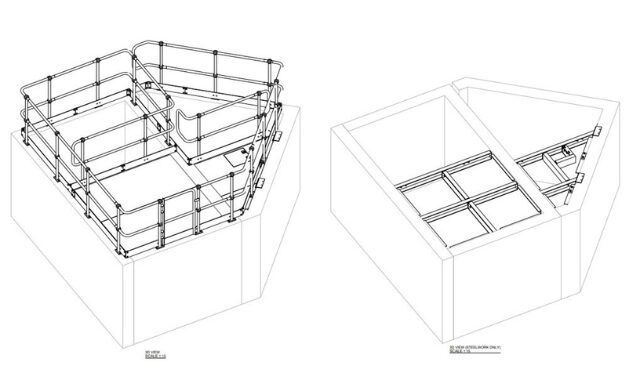
Figure 1: Final effluent platform GA
Installation
- Dismantling and removal of existing non-compliant handrailing, stations and fixings
- Engineers removed fixings on the gratings to allow the steelwork to be installed one beam at a time; gratings moved back in place after installation to act as a fall barrier
- Concrete drilled with slotted drive shaft (SDS) drills and steelwork secured in place with M12 wedge anchors
- After steelwork had been fitted, new OMF panels were secured in place with Hilti grating discs (Scottish Water specification)
- Steps repeated for both levels
- Edge protection was installed, handrail stanchions secured with M16 fixings and 32NB tube along with ball joints, fixed in place with solid dowel connectors and M8 grub screws
- Kickplate added to the handrailing with M10 U-bolts
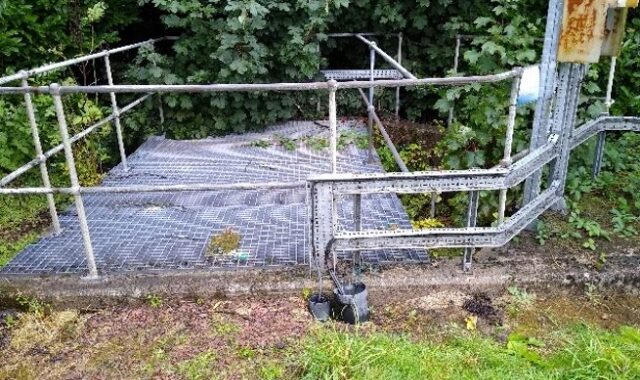
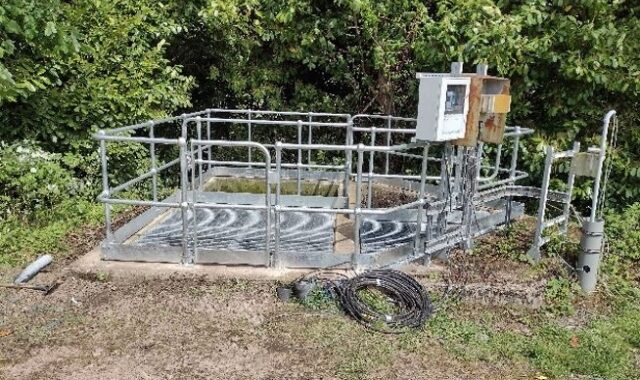
Figure 2 & Figure 3: Comparison photos
Job completion notes
- Due to the range in scope on this project, collaborative working between subcontractors was required. Any problem areas were addressed in accordance with best practice. The beam for the ASP area was assessed by our lifting appointed person (AP) for correct installation and the risk assessment method statement (RAMS) to implement it was put together in conjunction with the project engineer and the AP.
- Axiom identified the need for a regular testing programme for the installed steelwork at the inlet works to ensure the condition remains satisfactory.
- The works at Hamilton brought several areas of the site into a compliant state at the same time, improving the safety of personnel.
- Lesson learned – process with material management was highlighted as an improvement area.